
WIPO publishes the 2022 Global Innovation Index
In September this year, the World Intellectual Property Organization (WIPO) published the 15th edition of the Global Innovation Index. This is a report that measures and analyzes the innovation ecosystems of 132 countries (based on 81 indicators) and seeks to identify the most recent global innovation trends.
The theme of the 2022 report was "What is the future of innovation-driven growth?" and the analysis focused on the effects of innovation in three main areas: productivity, economic growth and social welfare. The report also considered the scenario of the ongoing Covid-19 pandemic and the emergence of new challenges on a global scale.
WIPO's Director General Daren Tang stated that one of the key objectives of the Global Innovation Index is "supporting countries at all stages of development to strengthen their innovation ecosystem". According to Mr. Tang, "more than a reference guide, the GII has established itself as a powerful tool for the construction and development of pro-inovation policies".
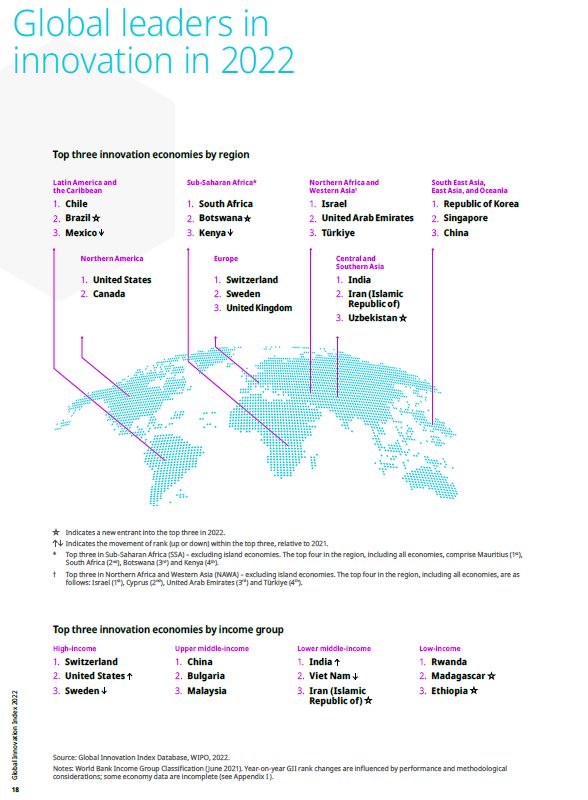
The top of the world ranking of the 2022 Global Innovation Index was occupied by Switzerland, the United States and Sweden, which were followed by the United Kingdom, the Netherlands, South Korea, Singapore, Germany, Finland and Denmark. China ranks 11th in the ranking, and is expected to enter the list of the world's 10 most innovative economies.
As for Brazil, the country advanced three positions in relation to the 2021 report and currently ranks 54th in the world ranking. Despite still falling short of its best mark ever achieved (the 47th place, achieved in 2011), Brazil has a prominent position in relation to the other countries in its region. Considering only Latin America and the Caribbean, Brazil ranks 2nd in the ranking, behind Chile.
The final result of each country in the world ranking is obtained from the average of two sub-indices:
- "Innovation Inputs", which analyzes items of the economy that enable and assist in the development of innovative activities, grouped into (i) institutions, (ii) human capital and research, (iii) infrastructure, (iv) market sophistication and (v) business sophistication; and
- "Innovation Outputs", which considers the real effects of innovative activities on the economy, divided into (i) knowledge and technology outputs and (ii) creative outputs.
Analyzing Brazil's position in each of the sub-indices, the country fell two positions in "Innovation Inputs" (from 56th to 58th place) and rose six positions in "Innovation Outputs" (from 59th to 53rd place). Among the factors for Brazil's considerable rise in "Innovation Outputs", we can mention the improvements in creative outputs (especially intangible assets and online creativity), as well as its prominent position in indicators such as trademarks registration (19th place) and mobile apps creation (34th place).
Finally, we highlight some general conclusions from the Global Innovation Index that we consider relevant:
- Investments in Research and Development (R&D) and other investments that drive innovative activities on a global scale continued to boom in 2021, despite the Covid-19 pandemic.
- The companies that invested the most in R&D in 2021 increased their expenditures by almost 10%, surpassing the USD 900 billion mark. This increase was driven mainly by the sectors of: ICT hardware and electrical equipment; Software and ICT services; pharmaceuticals and biotechnology; as well as construction and industrial metals.
Venture capital (VC) deals increased significantly by 46% in 2021, which can be compared to the record levels achieved with the Internet boom in the late 1990s. The regions that recorded the strongest VC growth were Latin America & the Caribbean and Africa.
>>> This article was written by our Intelectual Property associates: Pedro Tavares and Camila de Oliveira Lanor.