
COP26 and Climate Change Mitigation Technologies
In November 2021, the United Nations Climate Change Conference – COP26 took place in Glasgow, where signatory countries met to address climate change and make commitments, such as reductions in greenhouse gases (GHGs), that will directly impact the process of global warming and climate change, as well as protection of communities and natural habitats.
As a result of the conference, which was postponed from 2020 to 2021 because of the covid-19 pandemic, Brazil undertook to make a 50% reduction in GHGs by 2030, in comparison with 2005 levels. And as a signatory to the Global Methane Pledge led by the European Union, Brazil also committed to a 30% cut in methane emissions by 2030. Although additional mechanisms are needed to ensure that Brazil and other countries will effectively fulfill the commitments made at COP26, the conference establishes a milestone in the transition from the current industrial model to an environmentally more sustainable system.
Innovation is central to achieving the ambitions fixed at COP26, with the development of new technologies that will allow the transition to take place by focusing on targets such as GHG reductions, alternatives to polluting energy matrixes, and waste processing.
Further, the patent system has various contributions in the transition to a more environmentally-friendly economic model, offering both adequate protection for inventions, which encourages patent licensing agreements, and publicity of patents through the many patent offices around the world, which allows interested parties to monitor a significant portion of the innovation ecosystem, and to identify technological trends in the fight against climate change.
Thus, the commitments made at COP26, along with the patents system's contributions, are aligned with the demand by investors, corporations, and shareholders for development and use of technologies that are sustainable and, by preserving the environment, meet the requirements of the ESG agenda.
GHGs, which include methane and carbon dioxide, have a direct effect on climate change. In particular, the growing concentration of these gases in the atmosphere contribute to increases in the planet's average temperature, which in turn has driven priority development of the technologies known as CCMTs (Climate Change Mitigation Technologies) to slow down and halt global warming. Global adoption of CCMTs is fundamental to ensure that the goals negotiated at COP26 can be met, along with structured local policies and effective mechanisms for development and transfer of technology.
Aside from protecting technologies for inventors and owners, patents represent an important structured source of technological information. This makes it possible to apply metrics such as the degree of importance of a given technology within a given field and, consequently, provides businesses with better direction in making decisions, formulating policies and allocating budgets.
To give greater visibility to climate change mitigation technologies, a specific class for CCMTs was created in the Cooperative Patent Classification – CPC, which can be used in the databases of the main patent offices.
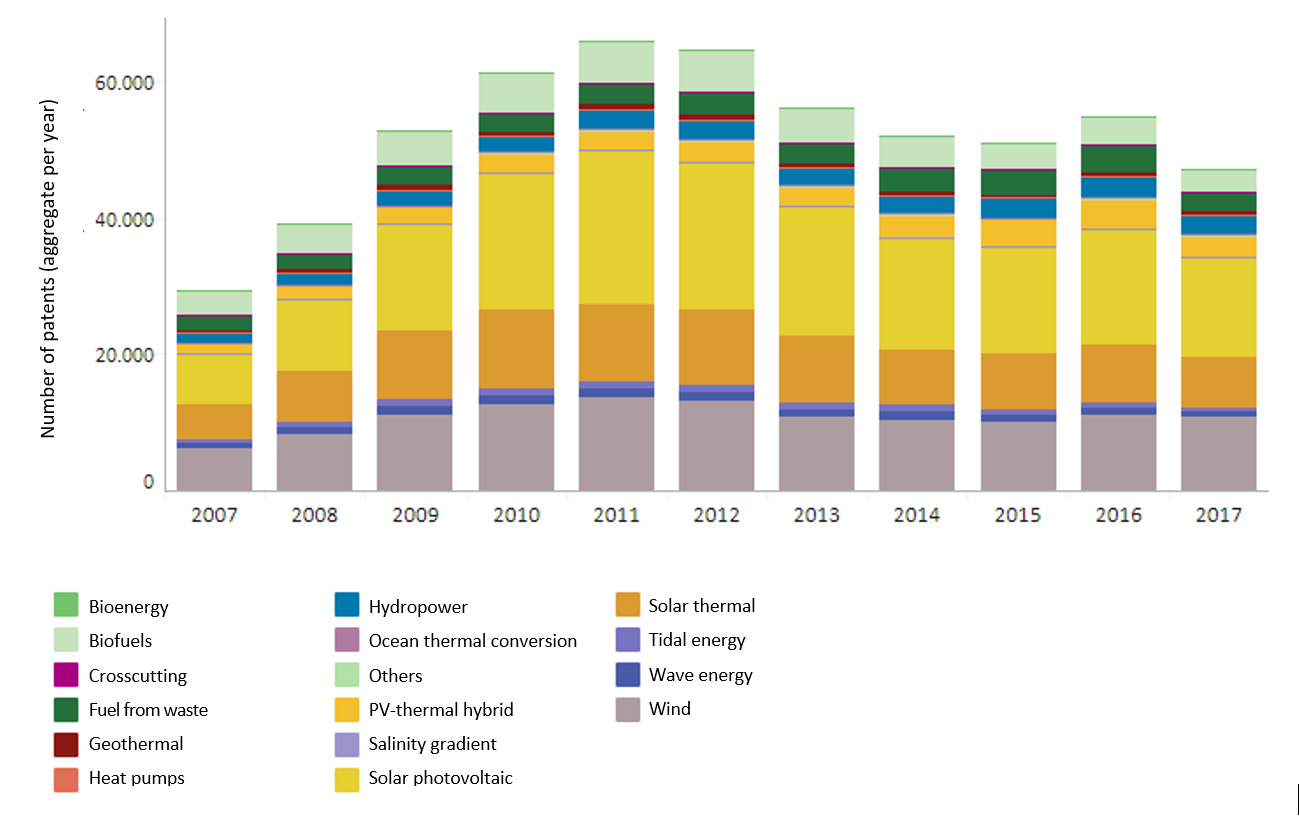
With this patent indexation strategy in place, trends can be identified at both national and international levels. For example, according to data obtained from the European Patent Office's PATSTAT1 system, since 2007 patent activity related to CCMTs has increased consistently around the world, possibly as a result of the commitments made under the Kyoto Protocol,2 with patent applications peaking in 2011. The technologies that show the largest number of applications include photovoltaic power generation, solar thermal power generation and wind power generation. Details on the number of applications around the world, classified by CCMT, per year from 2007 to 2017 are shown in the following chart:
Number of CCMT Patent Applications Globally (2007-2017):
Source: IRENA INSPIRE3 based on data from EPO PATSTAT
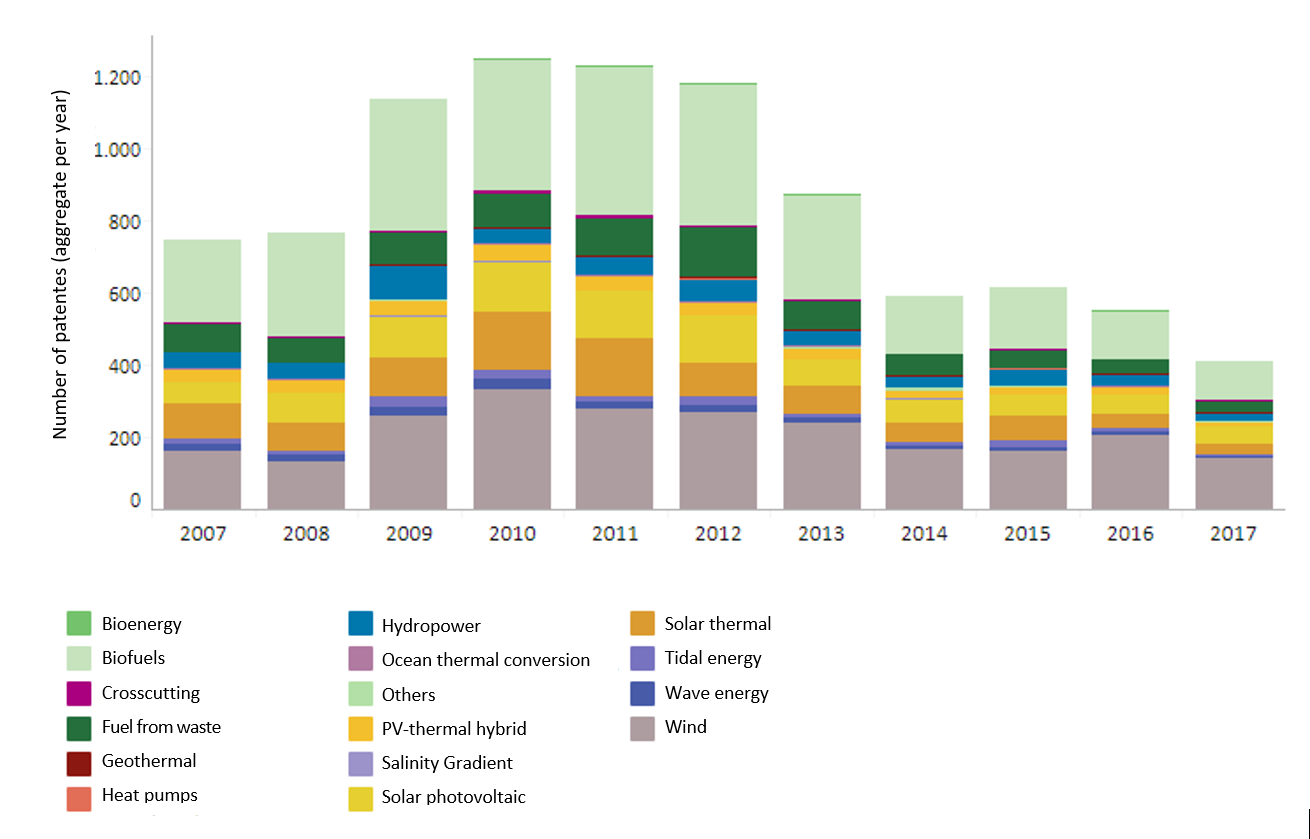
In Brazil, the CCMTs with the largest number of patent applications in the same period were biofuels, wind power generation, photovoltaic power generation, and solar thermal power generation. Details on the number of applications, classified by CCMT, per year in Brazil from 2007 and 2017 are shown in the following chart:
Number of CCMT Patent Applications in Brazil (2007-2017):
Source: IRENA INSPIRE based on data from EPO PATSTAT
With statistics such as these, which reveal trends in CCMTs, companies can develop strategies for their own technological development, or for entering into commercial partnerships involving transfer of technologies, that are better aligned with market expectations.
Specifically regarding transfer of CCMTs, one example is the WIPO Green, a project sponsored by the World Intellectual Property Organisation. WIPO Green is an online platform for exchange of technologies focused on climate change, which connects suppliers to those seeking environmentally friendly technologies, catalyzing CCMT innovation and diffusion around the world. Although it is not limited to patented technologies, the database allows new developments to be registered, along with information on any related patents and licenses. Currently, WIPO Green has more than 120,000 listed technologies, of which 386 are from Brazil, contributed by companies such as Petrobras, Vale and Embraer.
The "IP Storefront" (Vitrine de PI) hosted by the Brazilian Patent and Trademark Office ("INPI") must also be mentioned. The platform is not limited to CCTMs and listed technologies must be related to a patent application or patent granted by the INPI. This new technological service, along with various other improvements made over the last three years, is evidence of the INPI's effort to stimulate growth in patent applications in Brazil, and reflects Brazil's status as an "innovation achiever", according to the Global Innovation Index.1
In 2021, Brazil moved up five positions from its former rank, to 57th place. There is still a long way to go before Brazil joins the most innovative countries, such as Switzerland (1st place), Sweden (2nd place), the United States (3rd place), the United Kingdom (4th place), and South Korea (5th place). But there can be no doubt that actions such as strengthening the country's patent system can and should be one of the means to promote advances, particularly for CCMTs.
At a time when Brazil and other countries are looking for opportunities to create and develop sustainable technologies, strategic use of the patent system is a useful tool for businesses and entrepreneurs seeking growth aligned with the best market practices. BMA's intellectual property team is available to help identify opportunities and define efficient strategies to navigate the particularities of Brazil's IP legislation.
--
1 The European Patent Office's database – PATSTAT – contains bibliographic and legal event patent data for the main industrialized and developing nations.
2 Kyoto Protocol – an international treaty in effect since 2005.
3 https://www.irena.org/Statistics/View-Data-by-Topic/Innovation-and-Technology/Patents-Evolution
4 www.globalinnovationindex.org