
Brazil’s IP Strategy 2025–2027: Boosting Innovation, Competitiveness and Sustainable Development in Brazil
Brazil's intellectual property landscape is undergoing significant changes under the country's National Intellectual Property Strategy (ENPI) and the Brazilian Patent and Trademark Office (INPI)'s strategic initiatives. A new ENPI Action Plan 2025–2027 took effect in August 2025, aiming to expand the use of IP and to encourage innovation nationwide. This article examines key developments in Brazil's patent system in light of the national strategy. It will review recent patent filing trends, highlight ongoing public consultations shaping IP policy, outline modernization efforts in patent processing (digitalization, faster examinations, prioritization programs), and discuss positive advances in Brazil's IP system that support the strategy's goals.
Patent Filing Trends in Brazil: Growing Demand and Shifting Profile
Patent filing demand in Brazil has shown steady resilience. In 2024, a total of 27,701 patent applications were filed with INPI, against 27,918 in 2023 and 27,139 in 2022. Notably, filings by Brazilian residents rose 11.6% in 2024 – from 7,435 in 2023 to 8,304 in 2024 – marking the strongest growth in domestic filings since 2010. This rise in local innovation activity is a positive sign for Brazil's economy and is partially attributed to IP awareness and training programs led by INPI and other partners.
The majority of patent applications in Brazil continue to come from foreign companies seeking protection in its important market, but the share of domestic filings has inched upward. In 2022, about 25% of patent filings were from Brazilian residents, and by 2024 that share grew to 30%.
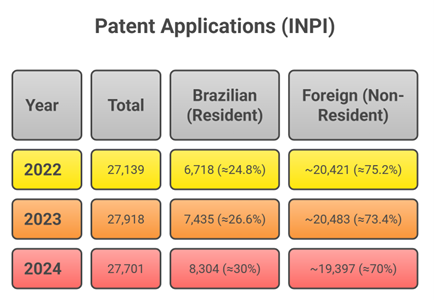
This balance of roughly two thirds foreign vs. one third domestic filings underscores Brazil's dual role as both a destination for international patent protection and a growing source of local innovation1. The United States is consistently the top foreign filer (about 25% of Brazil's patent applications in 2024), while Brazilian applicants themselves contributed around 30% of the filings in 20242. Other major applicant countries include China, Germany and Switzerland3.
Among Brazilian filers, about 33% of invention patent filings in 2024 were made by individual persons, with the remaining two-thirds filed by companies, universities, or other organizations. This highlights the inclusive nature of Brazil's innovation ecosystem – one where independent inventors and research institutions play an important role in addition to corporate R&D4.
Policy Development and Public Consultations: An Inclusive Approach
Brazil's IP authorities have embraced an inclusive approach to policy development, exemplified by multiple public consultations on patent law and policy. INPI regularly invites public to comment on proposed rule changes to ensure that examination guidelines and services reflect stakeholder needs. As of late 2025, several consultations are underway or recently concluded:
AI Patent Examination Guidelines (Consulta Pública Nº 03/2025): In August 2025, INPI opened a consultation on a draft guideline for examining patent applications related to Artificial Intelligence inventions, with the aim to sought input from the IP community on how AI-related innovations should be assessed.
New Uses in Chemistry Guidelines (Consulta Pública Nº 02/2025): In July 2025, INPI launched a consultation on revisions to the patent examination guidelines in the pharmaceutical and chemistry area, specifically concerning "new uses of known products" as, for example, a second medical use of a known compound.
This second topic has significant impact on pharma innovation which led to several key intellectual property associations and Brazilian companies to submit comments emphasizing the importance of aligning the examination of second medical use claims in Brazil with international best practices.
Each consultation is announced via the Official Gazette and INPI's channels, with clear instructions for interested parties to submit suggestions. After the comment period, INPI analyzes and consolidates the inputs before finalizing any new guideline.
The broader ENPI Action Plan 2025–2027 was also formulated with extensive stakeholder input. A Public Call for Contributions in 2023 gathered 246 proposals, over half of which were incorporated into the final plan. This inclusive approach is a positive evolution in Brazil's IP governance.
Modernization of Patent Processing at INPI: Efficiency and Digital Transformation
Central to Brazil's IP strategy is the modernization of INPI's patent application processing, aiming for a faster, more efficient, and digitally-driven patent office.
Backlog Reduction and Faster Examinations: INPI's Patent Backlog Combat Plan launched in 2019 targeted roughly 150,000 pending patent applications. By early 2024, the average examination pendency was down to 4.3 years5.
Digitalization and Process Automation: Patent filings in Brazil are now 100% electronic6. INPI has implemented e-government platforms and is exploring automation and AI tools to assist examiners. The office has launched online dashboards and open data portals for transparency7.
Prioritization Programs (Fast-Track Patents): INPI offers 18 modalities of prioritized examination, including Patent Prosecution Highway (PPH) agreements, green technologies, public health-related inventions, and applications from startups, senior inventors, and academic institutions8. In 2025, the PPH quota was raised to 3,200 applications per year split among different technology fields9.
Quality and Capacity Initiatives: INPI is training examiners in emerging technologies10, hiring new staff11, and implementing a new fee policy12 and management excellence model to sustain high performance.
Positive Developments and Outlook under the National Strategy
Higher Innovation Engagement: The surge in domestic patent filings and strong participation from academia and individual inventors indicate growing engagement with the IP system. The ENPI plan includes pilot programs to support technology transfer and commercialization.
Enhanced Global Standing: Brazil improved its global IP rankings, moving to 6th in trademark registrations and maintaining 11th in patent filings13. The ENPI plan sets ambitious targets to climb even higher14.
Dramatic Reduction in Pendency: The elimination of the patent backlog and reduction in examination times are transformative changes that restore credibility to Brazil's patent system.
Prioritizing Quality and Predictability: INPI's updated guidelines, international cooperation, and transparency measures contribute to a more reliable and user-friendly patent system.
Integration of IP into Economic Development Initiatives: The ENPI plan links IP with regional development, sustainability, and support for startups and small businesses. Initiatives include expanding IP education in the Amazon region and promoting green technology innovation in the context of COP30 (the 30th United Nations Climate Change Conference, hosted by Brazil in Belém in November 2025).
Stakeholder Engagement and Governance: The Interministerial Group on IP (GIPI) ensures coordination across 13 ministries and INPI. Civil society and industry representatives are actively involved in policy development and implementation oversight15.
Conclusion
Brazil's intellectual property system is undergoing a period of significant transformation, driven by coordinated efforts across government, industry, and civil society. The implementation of the National IP Strategy 2025–2027 and the modernization initiatives led by INPI reflect a deliberate shift toward a more efficient, transparent, and inclusive framework for managing patent rights.
The reduction in examination pendency, expansion of digital services, and diversification of prioritization programs demonstrate measurable progress in addressing longstanding structural challenges. These developments are not only improving the user experience for patent applicants but also aligning Brazil's IP infrastructure with international standards and best practices.
At the same time, the strategy's emphasis on stakeholder engagement, regional inclusion, and integration with broader economic and sustainability goals signals a more holistic approach to intellectual property governance. By placing IP policy within national development agendas, Brazil is positioning its system to better support innovation across sectors and regions.
While challenges remain—particularly in ensuring consistent quality, facilitating technology transfer, maintaining low average examination pendency—the trajectory is encouraging. Continued investment in institutional capacity, regulatory clarity, and public-private collaboration will be essential to sustaining these gains.
In this context, Brazil's evolving patent system offers valuable insights into how emerging economies can leverage intellectual property as a strategic tool for innovation, competitiveness, and inclusive growth. The coming years will be critical in translating policy ambitions into lasting institutional and economic outcomes.
NOTES
1 https://www.gov.br/inpi/pt-br/central-de-conteudo/noticias/RankingdeDepositantesResidentes2022.pdf e https://www.gov.br/inpi/pt-br/central-de-conteudo/estatisticas/arquivos/estatisticas-preliminares/ranking-de-depositantes-residentes-2023.pdf
6 https://www.gov.br/inpi/pt-br/servicos/sistemas-de-peticionamento
7 https://www.gov.br/inpi/pt-br/acesso-a-informacao/dados-abertos e https://www.gov.br/inpi/pt-br/central-de-conteudo/estatisticas/estatisticas
9 https://www.gov.br/inpi/pt-br/central-de-conteudo/legislacao/arquivos/documentos/portaria-dirpa.pdf
10 https://www.gov.br/inpi/pt-br/central-de-conteudo/legislacao/arquivos/documentos/portaria-dirpa.pdf