
Brazilian PTO starts processing applications for position marks
The Brazilian Patent and Trademark Office ("Brazilian PTO") took another step towards protecting the so-called non-traditional marks, specifically in relation to position marks. The regulation on position marks was introduced by Ordinance No. 37/2021, but the Brazilian PTO only started processing applications for these marks last November.
The lapse of time between Ordinance No. 37/2021 and the actual processing of applications for position marks was due to the need to adapt the Brazilian PTO's systems to receive applications for this new type of mark.
According to the Examination Guidelines of the Brazilian PTO, a position mark is "formed by the placement of a sign in a unique and specific position of a certain support, resulting in a distinctive set capable of identifying products or services and distinguishing them from other identical or similar ones, provided that the placement of the sign in the said position of the support can be dissociated from a technical or functional effect".
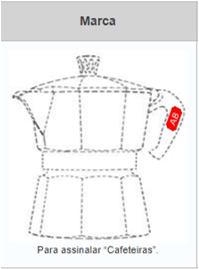
In other words, a position mark refers to the fixed and permanent position of a sign in a given support, provided that such a position is sufficiently distinctive. The purpose of the position mark, as well as of the other types of marks (namely, word, composite, figurative and three-dimensional marks), is to identify a product or service in the market, differentiating it from competing products or services. Below is an example of a position mark according to the Brazilian PTO Examination Guidelines:
As previously mentioned, position marks are considered non-traditional marks. And allowing registration for this type of mark before the Brazilian PTO is an old request from users of the national industrial property system.
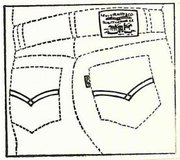
The discussions about position marks have become more prominent in our country after a few famous cases in the administrative and judicial spheres. For example, Levi Strauss & Co. brought a claim regarding the bow stitching in its pants pockets (pictured below). The sign was filed as a figurative mark in 1979 and granted only in 2014 (under registration number 790053853) after a long legal battle1.
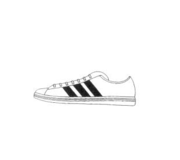
Another notable case was that of Adidas AG, which also adopted the strategy of registering the three stripes of its shoes (image below) as a figurative mark, but the grant decision regarding Registration No. 826054978 was challenged in court2. The relevant claim ended up being dismissed and the registration of the three stripes mark was maintained.

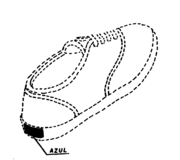
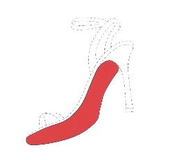
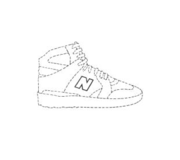
In addition to the cases above, one can also mention the blue label on the heel of Keds sneakers (Registration No. 817213260), the red sole of the Louboutin shoes (Registration No. 901514225), and the "N" on the side of the sneakers from New Balance (Registration No. 815547480), as shown in the following images:
Bearing in mind the importance of position marks for several companies, the new type of registration made available by the Brazilian PTO constitutes an actual advance for the Brazilian trademark system, securing protection for the relevant distinctive sets.
NOTES:
1 STJ. AgRg in Resp nº 638.033/RJ, Rapporteur: Minister Ricardo Villas Bôas Cueva, Judgment Date: 02/07/2013, Third Panel, Publication Date: DJe 02/19/2013.
2 TRF2 - Judgment: 0803946-89.2011.4.02.5101, Rapporteur: DES. EDF MESSOD AZULAY NETO, Judgment Date: 09/30/2014, 2nd Specialized Panel of the Federal Regional Court of the 2nd Region, Publication Date: 02/23/2015, Availability: DJe 02/20/2015.
>>> This article was written by our Intelectual Property associates: Pedro Tavares and Camila de Oliveira Lanor